


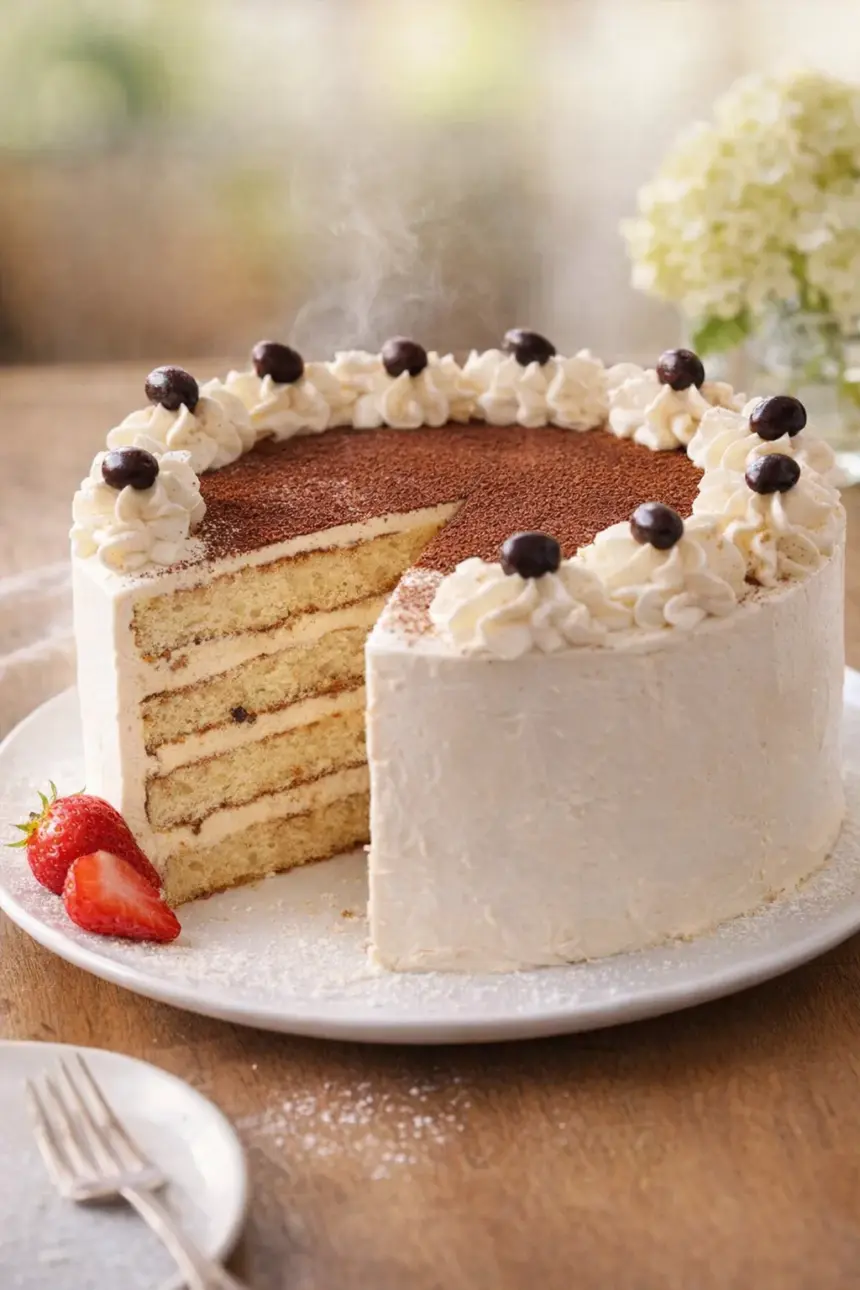
Making a showstopping celebration cake that actually tastes as impressive as it looks is one of the trickiest things a home baker can attempt. Most layer cakes either look beautiful but taste flat, or taste incredible but fall apart during assembly. This tiramisu cake solves both problems at once. It takes everything you love about the classic Italian dessert, the coffee-soaked layers, the mascarpone custard, the dusting of cocoa, and rebuilds it as a four-layer cake wrapped in espresso Swiss meringue buttercream. The result is celebration-worthy in every sense: deeply flavored, structurally sound, and genuinely unforgettable.
Why This Tiramisu Cake Works Before You Touch a Single Ingredient
The hardest part of this recipe is not the baking. It is the layering. Most home bakers run into trouble because they try to assemble a multi-layer cake while components are still warm or too loose, and the whole thing shifts and slides.
This recipe is built around a smart staging system. The mascarpone custard chills until it holds its shape. The buttercream gets whipped just before use. The coffee syrup cools before it hits the cake. Every component is designed to be structurally cooperative, not just flavorful.
The reverse-crumb method used for the sponge layers also matters here. By coating the flour in butter before adding the wet ingredients, you protect the gluten from overdevelopment. That means a more tender crumb even if you mix slightly longer than you should. It is a forgiving technique that rewards careful bakers and forgives impatient ones.
Ingredients for Tiramisu Cake
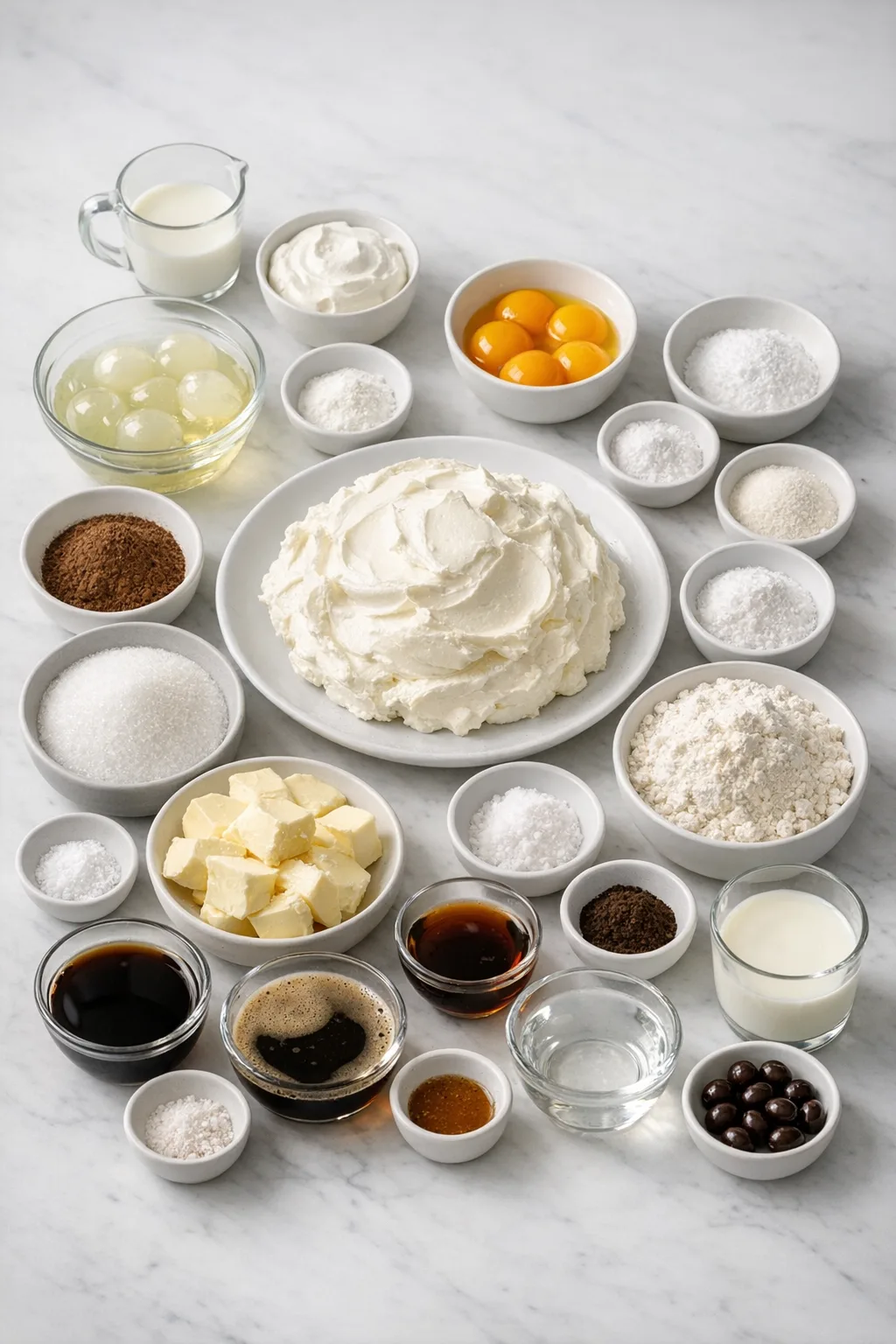
For the Vanilla Sponge
- ½ cup whole milk, room temperature (120ml)
- ½ cup sour cream, room temperature (120g)
- 5 large egg whites, room temperature
- 2 teaspoons vanilla extract
- 3 cups unbleached cake flour (360g)
- 2 cups granulated sugar (400g)
- 2 teaspoons baking powder
- ¾ teaspoon salt
- 1 cup unsalted butter, very soft (226g)
Ingredient note: Cake flour has less protein than all-purpose, which gives you a noticeably more delicate crumb. If you only have all-purpose flour, substitute 6 tablespoons of it with cornstarch across the full 3 cups. The sour cream is not just for moisture. As a mild acid, it tenderizes the gluten structure, making the layers softer and more absorbent for the coffee syrup.
Mascarpone Custard Filling
- 5 large egg yolks
- ½ cup granulated sugar (100g)
- 1 teaspoon cornstarch
- ¾ cup whole milk (180ml)
- 1 tablespoon coffee liqueur
- 16 ounces mascarpone cheese, room temperature (452g)
Espresso Swiss Meringue Buttercream
- 5 large egg whites, room temperature
- 1½ cups granulated sugar (300g)
- 1 pinch sea salt
- 2 cups unsalted butter, softened (454g)
- 1 teaspoon vanilla extract
- 3 tablespoons coffee liqueur
Coffee Soaking Syrup and Assembly
- ¾ cup hot water (180ml)
- 1½ teaspoons espresso powder
- 3 tablespoons coffee liqueur
- ¼ cup unsweetened cocoa powder (25g)
- 12 chocolate covered espresso beans, optional
Why Most Homemade Tiramisu Cake Fails (and How to Fix It)
Before you start baking, it helps to know where things typically go wrong with this style of cake.
- Warm components during assembly: Stacking layers with a warm custard or freshly made buttercream leads to a sliding, unstable cake. Chill every filling component before assembly, no exceptions.
- Skipping the buttercream dam: Without a piped border of buttercream around each layer’s edge, the mascarpone filling has nowhere to go but outward. The dam is structural, not decorative.
- Over-whisking the mascarpone: Mascarpone can curdle if beaten aggressively. Whisk it gently until smooth, then fold the custard in rather than stirring.
- Not soaking the cut side up: The cut surface of each sponge layer absorbs the coffee syrup far more efficiently than the smooth bottom. Always place layers cut side up when soaking.
- Serving immediately after assembly: The flavors need at least 1 hour in the refrigerator to meld. The cake actually tastes better the next day, when the coffee syrup has fully saturated each layer.
Step-by-Step Instructions
Prepare Your Pans and Build the Wet Base
Preheat the oven to 350°F. Lightly grease two 8-inch round cake pans with baking spray and line the bottoms with parchment paper. Wrapping the pans in soaked fabric baking strips is strongly recommended for flat, even layers.
In a large liquid measuring cup or medium Mixing Bowl, whisk together the milk, sour cream, egg whites, and vanilla extract. Set aside. You will know this is properly combined when the mixture looks uniformly pale and slightly frothy, with no streaks of sour cream visible.
Create the Reverse-Crumb Flour Base
In the bowl of a stand mixer fitted with the paddle attachment, combine the cake flour, granulated sugar, baking powder, and salt. Mix on low speed, then add the softened butter one tablespoon at a time until the mixture resembles coarse, wet sand, about 30 seconds to 1 minute. The texture should feel dense and slightly tacky when pressed between your fingers, not powdery.
One thing to watch: if you see large globs of butter rather than fine crumbs, the butter was too cold. Let the mixer run on low for another 30 seconds before proceeding.
Incorporate the Wet Ingredients Without Overworking
With the mixer running on low, drizzle in half of the milk mixture slowly. Mix until fully combined, then stop and scrape down the bowl. Add the remaining milk mixture on low, then beat on medium speed until the batter looks fluffy and thick, about 30 seconds. Scrape down and give one final mix by hand.
Divide the batter evenly between the two prepared pans. Bake for 35 minutes, or until a toothpick inserted in the center comes out clean. Cool in the pans for 15 minutes, then invert onto a wire rack, peel off the parchment, and cool completely before slicing.
Cook the Custard to the Right Consistency
Pour the whole milk into a small saucepan over medium heat and warm until it steams and just begins to bubble at the edges, about 2 to 3 minutes. Meanwhile, in a medium bowl, Whisk together the egg yolks, granulated sugar, and cornstarch until smooth and slightly pale.
Slowly pour the hot milk into the egg yolk mixture while whisking constantly, then return everything to the saucepan. Cook over medium-low heat, whisking constantly, until thickened, about 2 minutes. The custard is ready when it holds the trace of the whisk when you pull it through and reaches around 200°F. Remove from heat, stir in the coffee liqueur, transfer to a clean bowl, press plastic wrap directly onto the surface, and chill for 30 minutes to 1 hour until it reaches roughly room temperature (70 to 80°F). For speed, set the bowl in an ice bath and stir for about 5 minutes.
Fold the Mascarpone Into the Chilled Custard
Once the custard has cooled, gently whisk the mascarpone in a medium bowl until smooth. Fold in half of the custard first, working it in with a spatula until no streaks remain. Add the remaining custard and fold just until fully combined. Cover and refrigerate until ready to use.
If the filling looks slightly grainy, that is normal with mascarpone. A splash of up to ¼ cup of heavy cream folded in gently can smooth it out, but inside the assembled cake, the texture melts completely on the tongue.
Build the Swiss Meringue Buttercream
Add the egg whites, granulated sugar, and sea salt to a heatproof bowl set over a pot of simmering water, making sure the bowl does not touch the water. Whisk briefly to combine, then stir gently and constantly until the mixture reaches 160°F, about 8 to 10 minutes. At this point it should feel completely smooth between your fingers, with no graininess at all.
Transfer to the bowl of a stand mixer fitted with a whisk attachment. Beat on medium speed until the mixture becomes very fluffy, glossy, and holds soft peaks, and the outside of the bowl feels barely warm, about 10 to 12 minutes.
Reduce to medium-low and add the softened butter one tablespoon at a time, waiting for each piece to incorporate before adding the next. Once all the butter is in, add the coffee liqueur and vanilla. Increase to medium-high and beat until the frosting is fluffy and stiff enough to spread, about 2 to 3 minutes, scraping the bowl down occasionally.
If the frosting looks soupy at this stage, it is slightly too warm. Refrigerate the bowl for 5 minutes, then re-whip. If it looks lumpy and curdled, the butter was too cold. A few seconds with a hair dryer aimed at the outside of the bowl while the mixer runs will bring it together.
Transfer ¾ cup (128g) of buttercream to a piping bag fitted with a large closed star tip (Ateco 846 works well). Place another 1 cup into a piping bag fitted with a round tip (1A). Cover and set aside the rest.
Mix the Coffee Soaking Syrup
Stir together the hot water, espresso powder, and coffee liqueur in a small bowl. Set aside to cool slightly before using. The syrup should smell intensely of coffee and have a deep amber color when properly dissolved.
Slice and Assemble the Four-Layer Cake
Cut each cooled cake layer in half horizontally so you have four thin layers. Transfer the chilled mascarpone custard to a piping bag.
Place the first layer cut side up on a cake stand. Drizzle or brush about one-third of the coffee syrup (approximately 5 tablespoons) over the surface. Spread a thin layer of buttercream on top, then pipe a thin border around the edge using the round-tip piping bag to create a dam. Pipe about one-third of the mascarpone filling (1 cup) inside the dam and spread into an even layer. Dust lightly with cocoa powder.
Repeat this process twice more: cake layer cut side up, coffee syrup, thin buttercream, border dam, mascarpone filling, cocoa powder. For the final top layer, place it bottom side up for a smooth, flat surface.
Cover the top and sides with a smooth layer of the remaining buttercream. For a more relaxed finish, scrape the sides lightly for a naked look. For full coverage, leave the buttercream thick. Either way, the cake will look beautiful.
Finish with Cocoa and Decorative Dollops
Dust the top generously with cocoa powder. Use the back of a spoon to clear a clean ring around the edge of the top, removing the cocoa powder in that area so the buttercream dollops will adhere properly. Pipe the reserved star-tip buttercream in ruffled dollops around the cleared ring, making sure they touch for a clean, professional edge. Garnish every other dollop with a chocolate covered espresso bean.
Refrigerate the finished cake for at least 1 hour before slicing and serving.
What Separates a Good Tiramisu Cake from a Great One
- Use fabric baking strips: Wrapping your pans in damp fabric strips before baking prevents the edges from cooking faster than the center. The result is flat, even layers that stack cleanly without trimming.
- Whip the buttercream just before use: Swiss meringue buttercream loses its texture quickly once it sits. Give it a 30-second re-whip right before you use it for decorating, especially for the visible outer coat and dollops.
- Stage the cake over time: This is genuinely one of those recipes that benefits from being made in stages. Bake the sponge one day, make the custard and buttercream the next. Everything holds well refrigerated, and the assembly goes much more smoothly when you are not rushing.
- Espresso powder over brewed coffee: For the soaking syrup, espresso powder dissolved in hot water gives a more concentrated, consistent coffee flavor than brewed espresso, which can vary in strength. It is also far easier to control.
- Chill between layers if needed: On a warm day, if the assembled layers start to feel wobbly or unstable, stop and refrigerate the cake for 15 to 20 minutes before continuing. A cold, firm base makes the final coat of buttercream much easier to apply cleanly.
I personally prefer Mr. Black coffee liqueur in both the custard and the buttercream. It has a clean, intense coffee flavor that does not taste artificial, and it integrates into the mascarpone filling beautifully without making it too boozy.
Serving Suggestions
This tiramisu cake is rich enough to serve in modest slices. A thin wedge with a small cup of black coffee alongside it is the most natural pairing, letting the espresso notes in the cake echo in the drink.
For a dessert table with variety, the deep coffee and cream flavors here contrast well against something chocolatey and fudgy. An Amazing Chocolate Bundt Cake offers a denser, more intensely chocolate experience compared to this cake’s lighter, custard-layered structure, making the two a natural contrast on the same table.
For those who want to explore other creamy, rich dessert options that share the mascarpone-like richness of this cake, Cheesecake Brownies deliver a similarly indulgent cream-cheese-meets-chocolate combination in a much simpler, no-layer format.
Serve the cake cold, straight from the refrigerator. The mascarpone custard is firmer and more defined when cold, and the coffee flavor is more pronounced. Let slices sit at room temperature for about 10 minutes before eating if you prefer a softer texture.
Storage and Make-Ahead Notes
The assembled tiramisu cake keeps well in the refrigerator for up to 4 days. Store it covered or in a cake box to prevent it from absorbing other refrigerator odors.
The cake actually tastes better on day two. The coffee syrup has more time to soak fully into each sponge layer, making them softer and more saturated with flavor. If you are making this for an event, assembling it the evening before is genuinely the better approach.
Individual components can be made ahead separately. The sponge layers wrap well in plastic and keep at room temperature for one day or refrigerated for up to three days. The mascarpone custard keeps refrigerated for up to two days. The buttercream can be refrigerated for up to a week and re-whipped before use.
This cake is not suitable for freezing once assembled, as the mascarpone custard changes texture when frozen and thawed.
FAQs
Can I make the tiramisu cake without alcohol?
Yes. Replace the coffee liqueur in the custard, buttercream, and soaking syrup with an equal amount of strong brewed espresso or espresso powder dissolved in a small amount of water. The flavor will be slightly less complex but still deeply coffee-forward.
Why is my Swiss meringue buttercream soupy?
The most common cause is that the meringue was still too warm when the butter was added. Refrigerate the entire bowl for 5 minutes, then re-whip on medium-high speed. Repeat until the frosting stiffens. It will come together. The first time I made Swiss meringue buttercream, I panicked and threw the whole batch away, not realizing it just needed to cool down.
Can I use a hand mixer instead of a stand mixer?
A Hand Mixer can work for the sponge batter and the meringue, but the Swiss meringue buttercream requires sustained medium-speed beating for 10 to 12 minutes, which can be tiring. If using a hand mixer, make sure the bowl is stable and take breaks as needed.
How do I get clean, even cake layers when slicing horizontally?
Use a long serrated knife and rotate the cake slowly while keeping the knife level. Chilling the sponge layers for 30 minutes before slicing makes them firmer and much easier to cut cleanly. You will know the cut is even when both halves look identical in thickness from the side.
Can I make this as a two-layer cake instead of four?
Yes, though you will lose some of the layering effect that makes this cake visually striking. Skip the horizontal slicing step and assemble with two full layers. Reduce the mascarpone filling and coffee syrup proportionally, using roughly half the amount between the two layers.
How far in advance can I assemble the full cake?
The fully assembled cake can be refrigerated up to 24 hours before serving. Beyond that, the sponge layers may become overly saturated and soft. For best results, assemble no more than one day ahead and keep refrigerated until 10 minutes before serving.
A Cake Worth the Effort
There are recipes you make once and forget, and there are recipes that become your signature. This tiramisu cake tends to become the latter.
The process is involved, but every component serves a clear purpose, and the staging system means you are never overwhelmed all at once. Make the sponge, the custard, and the buttercream. Assemble. Each step is manageable on its own.
You will know the whole thing was worth it the moment you cut that first slice and see the four distinct layers with their coffee-stained edges, the pale mascarpone filling, and the cloud of espresso buttercream holding it all together. Give this one a try when you want to bring something genuinely impressive to the table. You will be glad you did.
Essential Kitchen Tools
Making Tiramisu Cake? Most failed attempts come from using the wrong pan or heat setup — not the recipe itself.

Want to save this recipe?
Want to save this recipe? Enter your email below, and we'll send it straight to your inbox. Plus, receive new recipes every week!

Foolproof Tiramisu Cake Recipe
- Total Time: 4 hours
- Yield: 12 servings 1x
Description
Indulge in the rich, creamy layers of this tiramisu cake, where soft cake meets smooth custard and a dusting of cocoa. Perfect for family gatherings, this baked Italian classic offers a delightful coffee-infused experience that will have everyone asking for seconds.
Ingredients
Ingredients for the Cake:
- ½ cup whole milk (room temperature (120ml))
- ½ cup sour cream (room temperature (120g))
- 5 large egg whites (room temperature)
- 2 teaspoons vanilla extract
- 3 cups unbleached cake flour (360g)
- 2 cups granulated sugar (400g)
- 2 teaspoons baking powder
- ¾ teaspoon salt
- 1 cup unsalted butter (very soft (226g))
- 5 large egg yolks
- ½ cup granulated sugar (100g)
- 1 teaspoon cornstarch
- ¾ cup whole milk (180ml)
- 1 tablespoon coffee liqueur
- 16 ounces mascarpone cheese (room temperature (452g))
- 5 large egg white (room temperature)
- 1½ cups granulated sugar (300g)
- 1 pinch sea salt
- 2 cups unsalted butter (softened (454g))
- 1 teaspoon vanilla extract
- 3 tablespoons coffee liqueur
- ¾ cup hot water (180ml)
- 1½ teaspoon espresso powder
- 3 tablespoons coffee liqueur
- ¼ cup unsweetened cocoa powder (25g)
- 12 chocolate covered espresso beans (optional)
Instructions
For the Cake:
- Set the oven temperature to 350ºF. Prepare two 8-inch round cake pans by lightly greasing them with baking spray and lining the bottoms with parchment paper. For even layers, consider wrapping the pans with soaked fabric baking strips.
- In a large liquid measuring cup or medium bowl, combine the milk, sour cream, egg whites, and vanilla extract by whisking them together. Set this mixture aside.
- In the bowl of a stand mixer with a paddle attachment, blend the flour, sugar, baking powder, and salt. Gradually incorporate the butter, one tablespoon at a time, while mixing on low speed until the mixture resembles coarse crumbs, which should take about 30 seconds to 1 minute.
- With the mixer on low, pour in half of the milk mixture and mix until just combined. Stop to scrape down the sides of the bowl, then add the remaining milk mixture. Increase the speed to medium and beat until the mixture appears fluffy, which should take about 30 seconds. Scrape down the bowl and mix again if necessary.
- Evenly distribute the batter between the two prepared pans. Bake for 35 minutes or until a toothpick inserted in the center comes out clean. Allow the cakes to cool in the pans for 15 minutes, then invert them onto a wire rack, remove the parchment paper, and let them cool completely.
For The Filling:
- In a small saucepan over medium heat, warm the milk until it begins to steam and bubble slightly around the edges, which should take about 2-3 minutes.
- While the milk is heating, whisk together the egg yolks, sugar, and cornstarch in a medium bowl until smooth. Set this mixture aside.
- Once the milk is hot, gradually whisk it into the egg yolk mixture until fully combined. Return the mixture to the saucepan and cook over medium-low heat, whisking gently and constantly until it thickens, which should take about 2 minutes. The custard should hold the trace of the whisk when pulled through it and reach a temperature of around 200°F.
- Remove the saucepan from the heat and stir in the coffee liqueur. Transfer the custard to a clean bowl and cover it with plastic wrap, pressing it directly onto the surface. Chill for 30 minutes to 1 hour until it reaches a temperature close to room temperature (70-80°F). To cool it quickly, you can place the bowl in an ice bath and stir with a spatula until cooled, which should take about 5 minutes.
- Once cooled, whisk the mascarpone in a medium bowl until smooth, then fold in half of the custard. Add the remaining custard and fold until no streaks remain. Cover and refrigerate until ready to use.
For the Buttercream:
- In a bowl large enough to sit over a pot of simmering water without touching it, combine the egg whites, sugar, and salt. Briefly whisk the mixture, then place the bowl over the pot. Stir the egg whites gently and continuously until they reach 160°F, which should take about 8-10 minutes.
- Transfer the egg white mixture to a stand mixer fitted with a whisk attachment. Beat on medium speed until the mixture becomes very fluffy, glossy, and forms soft peaks, and the bowl feels barely warm to the touch, which should take about 10-12 minutes.
- Lower the mixer speed to medium-low and incorporate the softened butter one tablespoon at a time, ensuring each piece is fully mixed in before adding the next.
- After all the butter is added, mix in the coffee liqueur and vanilla. Increase the speed to medium-high and beat until the frosting is fluffy and stiff enough to spread, which should take about 2-3 minutes. Stop occasionally to scrape down the bowl. (If the frosting is runny at this stage, refer to the Notes for troubleshooting tips.)
- Place ¾ cup (128g) of buttercream into a piping bag fitted with a large closed star tip (I used Ateco 846 tip). Place another cup of buttercream in a piping bag with a round tip (1A). Cover the remaining frosting and set it aside.
For the Assembly:
- In a small bowl, combine the water, espresso powder, and coffee liqueur. Allow the syrup to cool slightly.
- Slice the cooled cake layers in half horizontally to create four thin layers. Transfer the cooled mascarpone custard into a piping bag.
- Position the first layer, cut side up, on a cake stand. Drizzle or brush a third of the coffee syrup (approximately 5 tablespoons) over the top. Spread a thin layer of buttercream on top, then pipe a thin border around the edge of the cake using the reserved frosting with the round tip, creating a dam for the filling. Place a third of the mascarpone filling (1 cup) on top and smooth it out to the edges of the cake. Lightly dust the top with cocoa powder.
- Repeat this process twice more, starting with the cake layer cut side up and adding the coffee syrup, frosting, mascarpone filling, and cocoa powder. For the final top layer, position it bottom side up for a smooth finish.
- Apply a smooth layer of buttercream over the top and sides of the cake. (You can scrape the sides for a “naked” appearance, but if you prefer more buttercream, leave it thick.)
- Dust the top with cocoa powder. Use the end of a spoon to create a ring of cocoa powder around the edge of the cake’s top to allow your dollops to stick. Pipe dollops of buttercream in the clean ring around the top and decorate with chocolate-covered coffee beans. Refrigerate the cake for at least 1 hour before serving.
Notes
TECHNIQUE TIP: Pipe a buttercream border to secure the custard, ensuring stability in the multilayer cake.
STORAGE: Refrigerate the tiramisu cake overnight to enhance flavors and achieve the best texture.
SUBSTITUTION: Use mascarpone cheese instead of sour cream for a more traditional tiramisu flavor.
- Prep Time: 45 minutes
- Cook Time: 45 minutes
- Category: Dessert
- Method: Baked
- Cuisine: Italian
Nutrition
- Calories: 1064 kcal
- Sugar: 73 g
- Sodium: 308 mg
- Fat: 69 g
- Saturated Fat: 42 g
- Unsaturated Fat: 16 g
- Trans Fat: 2 g
- Carbohydrates: 99 g
- Fiber: 2 g
- Protein: 12 g
- Cholesterol: 250 mg


