



Watery zucchini lasagna is one of the most common frustrations home cooks face when trying to eat lighter without giving up the comfort foods they love. You swap the pasta for zucchini, follow the recipe, and pull a soggy, soupy mess out of the oven. The good news: this Zucchini Lasagna Recipe has a specific two-step technique that solves that problem completely before the dish ever hits the oven. The result is a hearty, layered casserole with a golden broiled top, a pull-worthy cheese interior, and a rich bolognese sauce that clings to every layer. At 360 calories and just 10 grams of carbs per serving, it delivers real satisfaction without the heaviness of traditional pasta lasagna.
Why Most Zucchini Lasagna Fails Before It Even Bakes
Zucchini is made up of mostly water. When you layer it raw into a casserole and bake it, that water releases directly into your sauce, turning everything thin and watery. Most recipes skip the fix entirely.
The solution here is two-fold: salt the zucchini slices first, which draws out excess moisture, and then pre-cook them on a grill or grill pan for just 2 minutes per side. That brief sear also adds a subtle smoky flavor that deepens the final dish in a way raw zucchini never could.
One thing to watch: if you skip the salting step and go straight to grilling, you will still get some moisture release during baking. Do both steps for the driest, most structured result.
Ingredients for Zucchini Lasagna
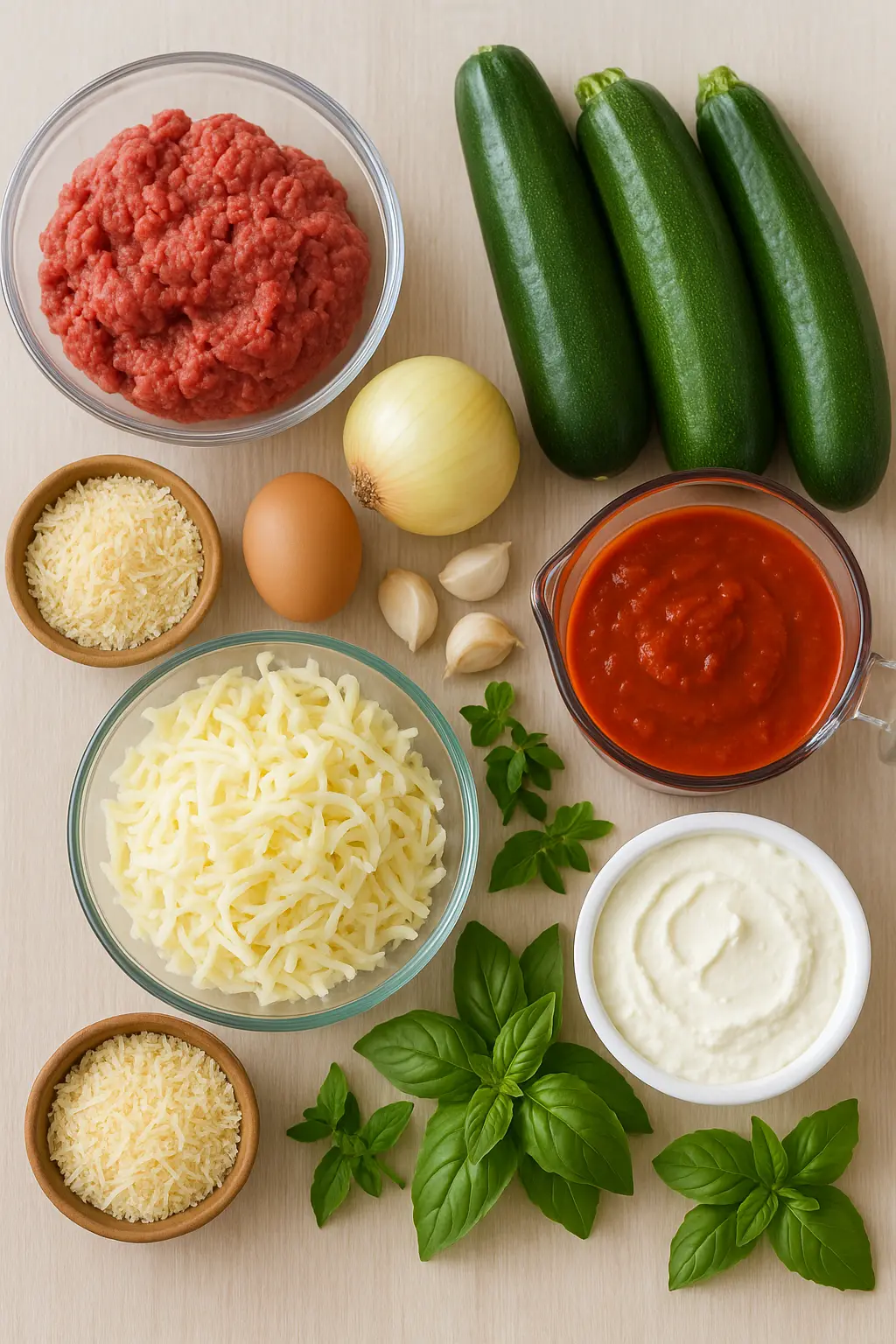
Every component in this recipe has a specific job. Here is what you need and why it matters.
Zucchini Layer
- 2 lbs zucchini (4-5 medium/large, cut into 1/4-inch thick slices or rings)
- 1 tbsp olive oil or cooking spray (plus more for the meat sauce)
- 3 1/2 tsp fine sea salt, divided
- 1 tsp freshly ground black pepper
Meat Sauce
- 1 1/2 lbs ground beef (15-20% fat content, which keeps the sauce rich and not dry)
- 1 cup yellow onion, chopped
- 3 garlic cloves, minced
- 24 oz pasta sauce, homemade or store-bought
- 1/4 cup chopped basil or parsley, divided
Cheese Layer
- 4 cups shredded mozzarella cheese, divided
- 15 oz reduced-fat ricotta cheese
- 1 cup shredded parmesan cheese
- 1 large egg (the egg binds the ricotta mixture so it holds its shape between layers rather than sliding around)
If you cannot find reduced-fat ricotta, part-skim or whole-milk ricotta both work. For the pasta sauce, avoid anything labeled “thin” or “light” in texture. Invert the jar before buying and watch how quickly it moves. A sauce that barely shifts is the one you want.
Step-by-Step Instructions
Step 1: Draw Out Moisture and Build Flavor in the Zucchini
Preheat an outdoor grill, grill pan, or large skillet to medium-high heat. Slice zucchini into 1/4-inch thick long slices or rings, discarding the ends. A mandolin slicer gives you the most even cuts, which means more consistent cooking. Always use a safety glove when working with a mandolin.
Spray or brush both sides lightly with olive oil, then season all over with about 2 tsp salt and 1/2 tsp pepper. Grill for 2 minutes per side over medium-high heat until crisp-tender. The slices should have visible grill marks and feel slightly softened but still hold their shape when lifted. Transfer to a platter to cool.
If your zucchini still looks wet after grilling, pat the slices dry with a paper towel before assembling.
Step 2: Build a Deeply Flavored Meat Sauce
Preheat the oven to 375°F. Place a deep saucepan or Dutch oven over medium-high heat and add 1 tbsp olive oil and the ground beef. Sauté, breaking it up with a spatula, until browned, about 5 minutes. Drain off all but 2 tbsp of fat.
Add the diced onions and sauté for 5 minutes until softened and translucent. Add the garlic and sauté for another minute until fragrant. The kitchen should smell nutty and savory at this point, not sharp or raw. Add the pasta sauce, half of the basil or parsley, 1 tsp fine sea salt, and 1/2 tsp pepper. Bring to a low boil, then cover and simmer for 10 minutes, stirring occasionally. Remove from heat and set aside.
If the sauce looks thin after simmering, cook it uncovered for an additional 3-5 minutes before assembling. A watery sauce going in means a watery lasagna coming out.
Step 3: Mix a Ricotta Layer That Holds Its Shape
In a mixing bowl, combine 1 cup mozzarella, the ricotta cheese, parmesan, 1 egg, the remaining basil or parsley, and 1/2 tsp fine sea salt. Stir until fully combined. The mixture should look thick and spreadable, almost like a dense dip, not runny.
I personally prefer shredded parmesan over grated here. It melts into the ricotta layer more evenly and gives the cheese sauce a slightly stringy, cohesive texture that grated parmesan cannot quite replicate.
Step 4: Layer with Intention for Even Cooking
Spread 1/2 cup of meat sauce in the bottom of a 9×13 casserole dish. This thin base layer prevents the zucchini from sticking. Add a single layer of zucchini slices, then spread 1/3 of the meat sauce over the top. Sprinkle with 1 cup of shredded mozzarella, then spoon on and spread half of the ricotta cheese mixture.
Repeat the process: another layer of zucchini, 1/3 meat sauce, 1 cup mozzarella, and the remaining ricotta mixture. Finish with your final layer of zucchini, the last 1/3 of meat sauce, and the remaining 1 cup of mozzarella on top. You will have 3 complete layers of zucchini when done.
Step 5: Bake Covered, Then Broil for the Golden Crust
Poke 9-12 toothpicks across the surface of the lasagna to keep the foil from pressing into the cheese. Cover with foil and bake at 375°F for 40-45 minutes. You will know it is ready when small bubbles appear around the outer edges and the sauce is visibly active.
Remove the foil and the toothpicks, then switch the oven to broil. Broil for 3-4 minutes until the top is golden and bubbling. Watch it closely during this step. Thirty seconds too long and you will have burnt cheese instead of a golden crust. Rest for 15 minutes before slicing.
Use a serrated knife to cut through the layers cleanly. The resting time is not optional: skipping it means the layers slide apart the moment you lift a piece.
What Separates a Good Zucchini Lasagna from a Great One
- Slice thickness matters: Cut at exactly 1/4 inch. Thicker slices release more water and take longer to soften. Thinner slices can disintegrate during baking.
- Do not rush the meat sauce simmer: Ten minutes of simmering concentrates the sauce and reduces excess liquid. A well-reduced sauce is the single biggest factor in avoiding a watery final dish.
- Spoon the ricotta, then spread: Because the cheese mixture is thick, dropping it in spoonfuls across the surface before spreading prevents it from dragging the layers underneath out of place.
- Two skillets indoors: If you are cooking the zucchini on a stovetop grill pan, run two pans simultaneously to cut the prep time significantly.
- Let it rest fully: The first time I made this, I sliced into it after only 5 minutes. The filling ran across the cutting board. Fifteen minutes of resting is what allows the layers to set into clean, stackable slices.
Make It Once, Use It All Week
This lasagna stores and reheats better than most casseroles. The layers actually firm up overnight, making the next-day slices cleaner and easier to serve.
- Refrigerator: Cover and refrigerate leftovers for up to 5 days.
- Freezer: Cover with foil and freeze for up to 3 months.
- To reheat from refrigerator: Cover with foil and bake at 350°F for 15-25 minutes, depending on portion size. The dish is ready when the cheese is melted and you can see the sauce bubbling gently around the edges.
- To reheat from frozen: Thaw in the refrigerator overnight first, then bake covered at 350°F for up to 40 minutes.
- Make-ahead assembly: Layer the entire dish, cover, and refrigerate or freeze before baking. Pull it out and bake when ready.
What to Serve Alongside
Because the lasagna is rich and hearty on its own, lighter sides work best. A crisp Caesar salad or a simple garden salad cuts through the richness of the cheese layers. Caprese salad adds a fresh, acidic contrast that balances the savory bolognese.
If you want something to soak up the extra sauce, garlic bread or focaccia alongside works well. For a fully low-carb meal, roasted vegetables are a natural fit.
Conclusion
Zucchini lasagna is not a compromise. When the zucchini is properly prepped, the sauce is well-reduced, and the broiler does its job at the end, what comes out of the oven is genuinely satisfying in the same way classic lasagna is.
Give this one a try the next time you have a pile of garden zucchini or want a pasta-free dinner that does not feel like a sacrifice. You might find yourself making it on rotation long after zucchini season ends.
Must-Try Low-Carb Recipes for Healthy Eating
- Lasagna Stuffed Chicken (Cheesy & Satisfying) — Perfect for cozy dinners with a cheesy delight.
- 3-Ingredient Cauliflower Mashed Potatoes (Creamy & Smooth) — Ideal for a quick side dish with a creamy texture.
- Italian Tomato Sauce With Basil (Rich & Flavorful) — Great for enhancing pasta dishes with a rich flavor.
FAQs
Why is my zucchini lasagna watery even after pre-cooking the zucchini?
The most common cause is a pasta sauce that was too thin to begin with. Check the sauce before assembling: it should coat the back of a spoon and hold a line drawn through it. If the lasagna still looks watery after baking, remove the foil and cook uncovered for an additional 15 minutes before broiling.
Can I make this Zucchini Lasagna Recipe without meat?
Yes. Omit the ground beef and use a vegetarian marinara sauce in its place. The cheese layers remain exactly the same, and the dish is still filling and satisfying without the meat.
Can I substitute yellow squash for zucchini?
You can, though yellow squash tends to be smaller and less uniform in shape, which makes even layering trickier. The flavor is slightly different but still works. Eggplant sliced to the same 1/4-inch thickness is another solid option.
How do I keep the foil from sticking to the cheese during baking?
Poke 9-12 toothpicks across the surface of the lasagna before covering with foil. The toothpicks act as a tent frame, holding the foil just above the cheese so it does not fuse to the top layer during the 40-45 minute bake.
Can I assemble this lasagna the night before?
Absolutely. Layer the entire dish, cover tightly, and refrigerate overnight. Bake directly from the refrigerator the next day, adding about 10 extra minutes to the covered baking time to account for the cold start.
What is the best tool for slicing zucchini evenly?
A mandolin slicer set to 1/4 inch gives the most consistent results and is significantly faster than a knife. Always use a cut-resistant safety glove when using a mandolin. A large vegetable peeler is a workable alternative if you do not own a mandolin.
Essential Kitchen Tools
Making Zucchini Lasagna Recipe? Most failed attempts come from using the wrong pan or heat setup — not the recipe itself.

Want to save this recipe?
Want to save this recipe? Enter your email below, and we'll send it straight to your inbox. Plus, receive new recipes every week!

Light Zucchini Lasagna Recipe
- Total Time: 1 hour 25 minutes
- Yield: 12 people 1x
Description
Irresistibly cheesy and saucy zucchini lasagna with layers of grilled zucchini, rich meat sauce, and creamy cheese sauce.
Ingredients
- 2 lbs zucchini (4–5 medium/large, sliced into 1/4” thick pieces or rings*)
- 1 tbsp olive oil or cooking spray (plus additional for meat sauce)
- 3 1/2 tsp fine sea salt (divided)
- 1 tsp freshly ground black pepper
- 1 1/2 lbs ground beef (15-20% fat content)
- 1 cup yellow onion (chopped)
- 3 garlic cloves (minced)
- 24 oz pasta sauce (homemade or store-bought)
- 1/4 cup chopped basil or parsley (divided)
- 4 cups shredded mozzarella cheese (divided)
- 15 oz reduced-fat ricotta cheese
- 1 cup shredded parmesan cheese
- 1 large egg
Instructions
- Begin by preheating your outdoor grill, grill pan, or large skillet to medium/high heat. Cut the zucchini into long slices or rings, about 1/4” thick, and discard the ends. Lightly coat both sides with olive oil and season generously with approximately 2 tsp of salt and 1/2 tsp of pepper. Grill for 2 minutes on each side until they are crisp-tender.
- Next, preheat your oven to 375°F. In a deep saucepan or Dutch oven over medium/high heat, add 1 tbsp of olive oil along with the ground beef. Cook while breaking it apart with a spatula until it is browned, which should take about 5 minutes. Drain off all but 2 tbsp of the fat.
- Incorporate the diced onions and sauté for 5 minutes, then add the minced garlic and cook for an additional minute. Pour in the pasta sauce and half of the chopped basil or parsley. Season with 1 tsp of fine sea salt and 1/2 tsp of pepper. Allow it to reach a low boil, then cover and let it simmer for 10 minutes, stirring occasionally. Adjust seasoning to taste, then remove from heat and set aside.
- In a mixing bowl, combine 1 cup of mozzarella, ricotta cheese, parmesan, 1 egg, the remaining basil or parsley, and 1/2 tsp of fine sea salt. Mix thoroughly.
- Spread 1/2 cup of the meat sauce in the bottom of a 9×13 casserole dish. Layer with zucchini, then add 1/3 of the meat sauce, followed by 1 cup of mozzarella. Top with half of the cheese mixture. Repeat this layering process until you have three layers of zucchini.
- To prevent the foil from sticking to the cheese, poke 9-12 toothpicks into the surface of the lasagna. Cover with foil and bake in the preheated oven at 375°F for 40-45 minutes. Afterward, remove the foil and broil for 3-4 minutes to achieve a golden cheesy top. Allow it to rest for 15 minutes before slicing, and garnish with basil or parsley if desired before serving.
Notes
TECHNIQUE TIP: Use a mandolin slicer set to 1/4 inch for even zucchini slices. Wear safety gloves for protection.
STORAGE: Store leftover zucchini lasagna in an airtight container in the refrigerator for up to 3 days.
SUBSTITUTION: For a vegetarian option, substitute ground beef with mushrooms or lentils for a hearty texture.
- Prep Time: 30 minutes
- Cook Time: 40 minutes
- Category: Main Dish
- Method: Baking
- Cuisine: Italian
Nutrition
- Serving Size: 1 slice
- Calories: 360 kcal
- Sugar: 5 g
- Sodium: 1402 mg
- Fat: 24 g
- Saturated Fat: 11 g
- Unsaturated Fat: 10 g
- Trans Fat: 1 g
- Carbohydrates: 10 g
- Fiber: 2 g
- Protein: 27 g
- Cholesterol: 96 mg


